Automated Trading vs Manual Trading: The Ultimate 2024 Showdown
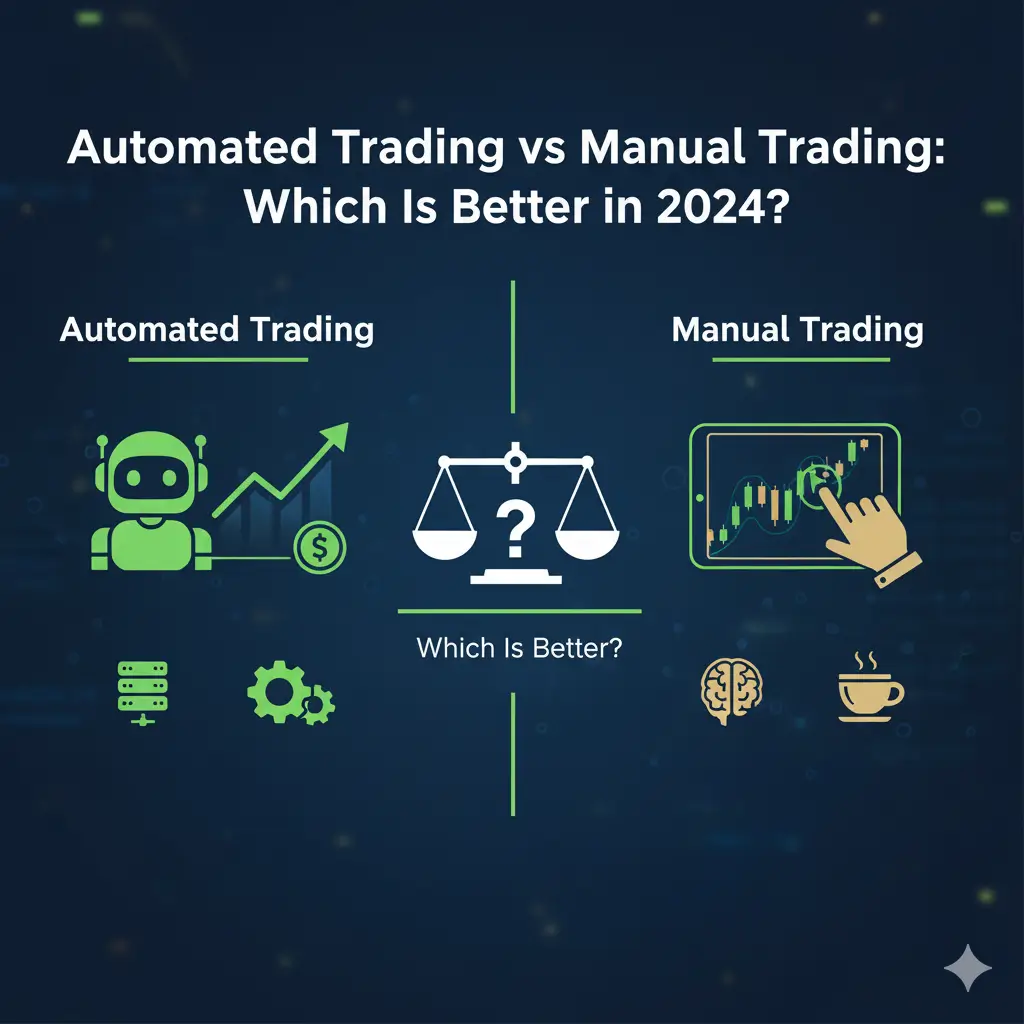
In 2024, forex traders face a critical decision: embrace automated trading or stick with traditional manual methods. This comprehensive guide reveals which approach truly generates better returns, fits different lifestyles, and leads to long-term success.
The State of Forex Trading in 2024
The forex market has evolved dramatically. With $7.5 trillion daily volume and advanced technology, traders now have unprecedented tools at their disposal. But the fundamental question remains: Should you automate or trade manually?
Key Statistics:
- 75% of forex volume is algorithmic
- Automated trading systems manage $4 trillion daily
- Manual traders account for only 25% of volume
- Professional traders use EAs 80% of the time
What is Automated Trading?
Automated trading uses computer programs (Expert Advisors or EAs) to execute trades based on predefined rules. No human intervention needed once configured.
How It Works:
- Define trading rules and parameters
- Program or configure the EA
- Set risk management rules
- Let the software trade 24/5
- Monitor and adjust as needed
What is Manual Trading?
Manual trading involves making all trading decisions yourself - identifying setups, entering trades, managing positions, and exiting based on your analysis.
The Process:
- Analyze market conditions
- Identify trading opportunities
- Execute trades manually
- Manage positions actively
- Make exit decisions based on price action
Head-to-Head Comparison
| Factor | Automated Trading | Manual Trading |
|---|---|---|
| Speed | Milliseconds | Seconds to minutes |
| Emotion | Zero emotion | Emotions affect decisions |
| Trading Hours | 24/5 possible | Limited by human capacity |
| Consistency | 100% rule adherence | Variable consistency |
| Backtesting | Easy and accurate | Difficult and biased |
| Scalability | Multiple pairs/timeframes | Limited human capacity |
| Learning Curve | Technical setup | Years of practice |
Performance Analysis: Which Makes More Money?
Automated Trading Performance
Average Returns: 15-40% annually with proper risk management
Win Rate: 40-60% (not critical with good R/R)
Drawdown: Typically 10-20%
Consistency: Monthly positive returns 80% of time
Manual Trading Performance
Average Returns: Variable (-50% to +100%)
Win Rate: 50-70% for experienced traders
Drawdown: Can exceed 50% during bad periods
Consistency: Monthly positive returns 40-60% of time
Pros and Cons Deep Dive
Automated Trading Pros
- Eliminates Emotions: No fear, greed, or revenge trading
- 24/5 Trading: Never miss opportunities in any session
- Speed: Instant execution, no delays
- Backtesting: Validate strategies on years of data
- Multi-Market: Trade multiple pairs simultaneously
- Consistency: Rules followed 100% of time
Automated Trading Cons
- Technical Issues: Internet, power, software failures
- Market Adaptation: May need re-optimization
- Over-Optimization: Risk of curve fitting
- Initial Cost: Quality EAs can be expensive
- Limited Flexibility: Can't adapt to unexpected events
Manual Trading Pros
- Flexibility: Adapt to any market condition
- Intuition: Human judgment for unique situations
- News Trading: React to fundamental events
- Learning: Deep market understanding
- No Technical Issues: Just you and the chart
Manual Trading Cons
- Emotional Trading: Fear, greed, hope affect decisions
- Limited Hours: Can't trade 24/5
- Inconsistency: Rules may be broken
- Slow Execution: Manual delays
- Analysis Paralysis: Overthinking trades
- Burnout: Mental exhaustion
Who Should Choose Automated Trading?
Ideal Candidates:
- Busy Professionals: Limited time for analysis
- Systematic Thinkers: Prefer rules-based approach
- Multiple Currency Traders: Need to monitor many pairs
- Risk-Averse Traders: Want strict risk management
- New Traders: Haven't developed skills yet
- Quantitative Minds: Enjoy data and optimization
Required Skills:
- Basic computer literacy
- Understanding of risk management
- Patience for optimization
- Ability to monitor performance
Who Should Choose Manual Trading?
Ideal Candidates:
- Experienced Traders: Have proven strategies
- Full-Time Traders: Time for deep analysis
- Discretionary Traders: Use intuition and patterns
- News Traders: React to fundamental events
- Psychology Masters: Control emotions well
Required Skills:
- Technical analysis mastery
- Emotional control
- Patience and discipline
- Years of practice
The Hybrid Approach: Best of Both Worlds
Many successful traders use a hybrid approach:
- Automated: Trend following on major pairs
- Manual: News events and volatile periods
- Automated: Range-bound markets
- Manual: Major trend reversals
Implementation Steps:
- Automate 60-70% of your trading
- Keep 30-40% for discretionary trades
- Use EAs for trending/ranging markets
- Manually trade during high-impact news
- Review performance monthly
Cost Analysis: Which is More Profitable?
Automated Trading Costs
- EA Purchase: $299-$999 (one-time)
- VPS: $20-$50/month
- Optimization Time: 10-20 hours initially
- Monitoring: 2-3 hours/week
Manual Trading Costs
- Education: $500-$5000
- Tools: $100-$300/month
- Time Investment: 20-40 hours/week
- Psychological Cost: Stress and burnout
ROI Comparison (First Year):
Starting with $10,000:
- Automated: $1500-$4000 profit (15-40%)
- Manual: -$5000 to $10,000 profit (-50% to +100%)
- Hybrid: $2000-$6000 profit (20-60%)
Real Trader Case Studies
Case Study 1: Sarah - Automated Trader
Background: IT professional, 35 years old
Approach: TrendCatch Pro EA on 5 major pairs
Results:
- Month 1: +8.2%
- Month 2: +12.5%
- Month 3: +6.8%
- 6-month average: +9.8% monthly
Time Commitment: 2 hours/week
Case Study 2: Mike - Manual Trader
Background: Full-time trader, 10 years experience
Approach: Price action on EUR/USD and GBP/USD
Results:
- Month 1: -15%
- Month 2: +25%
- Month 3: +18%
- 6-month average: +5.2% monthly
Time Commitment: 40 hours/week
Case Study 3: Lisa - Hybrid Trader
Background: Part-time trader, 3 years experience
Approach: EA for trends, manual for reversals
Results:
- Month 1: +11%
- Month 2: +14%
- Month 3: +9%
- 6-month average: +11.3% monthly
Time Commitment: 10 hours/week
Future of Forex Trading: 2025 and Beyond
AI and Machine Learning
- Self-learning EAs that adapt to markets
- Neural networks for pattern recognition
- Predictive analytics integration
- Sentiment analysis automation
Technology Trends
- Cloud-based trading platforms
- Mobile trading dominance
- Social trading integration
- Blockchain in forex
Making Your Decision: A Personalized Approach
Answer these questions to determine your best approach:
- How much time can you dedicate weekly?
- What's your risk tolerance?
- Are you comfortable with technology?
- Do you have proven trading strategies?
- How emotional are you about money?
- What's your initial capital?
- Are you trading for income or growth?
Decision Matrix:
Choose Automated if:
- Limited time (<10 hours/week)
- Emotional trader
- Prefer systematic approach
- Want consistent returns
- Technology comfortable
Choose Manual if:
- Plenty of time (>30 hours/week)
- Excellent emotional control
- Proven profitable strategies
- Enjoy trading process
- Experienced trader
Choose Hybrid if:
- Moderate time (10-30 hours/week)
- Good emotional control
- Want automation plus flexibility
- Like technology and charts
- Intermediate to advanced
Final Recommendation
For 2024 and beyond, the hybrid approach offers the best balance of automation benefits and human flexibility. Start with automated trading for consistency and experience, then gradually add manual trades as you develop skills.
Getting Started Path:
- Month 1-3: Pure automation with TrendCatch Pro
- Month 4-6: Add 1-2 manual trades weekly
- Month 7-12: Optimize based on performance
- Year 2: Maintain 70/30 automated/manual split
The choice between automated and manual trading ultimately depends on your personality, lifestyle, and goals. But one thing is certain: technology is the future of forex trading. Embracing automation, even partially, will give you a significant edge in the competitive forex market.